

Leather Belt Manufacturers
This buyer-focused guide is designed for professional sourcing teams looking for Leather Belt Manufacturers. It explains the commercial and technical information worth comparing before a buyer moves from discovery to samples, due diligence and an order. Directory profiles can show what a business supplies, the roles it claims, the markets it serves and which verification checks have actually been completed.
What to establish with a manufacturer
Separate genuine manufacturing capability from trading or sourcing. Ask which production stages are carried out at the declared facility, which operations are subcontracted, what machinery and skilled processes are available, normal minimum orders, sample-development process, lead times, quality-control points and experience with OEM, ODM or private-label work. If tooling, dies, moulds, patterns or branded hardware are required, agree ownership and storage before production.
Write the specification before comparing prices
Specify finished belt width, thickness, size range, buckle material and finish, hole pattern, edge treatment, stitching, branding position, packaging and whether straps are cut from full-grain, corrected-grain or another specified leather.
A useful RFQ should also state estimated annual demand where known, sample quantity, acceptable tolerances, delivery destination, preferred Incoterm if relevant and whether the quotation should include tooling, packaging, testing, freight or duties. Quotes are much easier to compare when every supplier is pricing the same specification.
Samples, quality and repeatability
Samples should be checked for consistent width and thickness, clean edge finishing, buckle security, stitch quality, colour consistency, flex performance and the accuracy of logos or debossing.
Keep an approved reference where practical and record measurable tolerances separately. For leather, that can include thickness, colour, temper, finish, usable area and physical tests. For finished goods, it can include dimensions, stitch density, edge finish, hardware, logo position, packing and functional checks. A pre-production sample is useful only if the bulk-order acceptance criteria are also understood.
Verification: understand exactly what has been checked
A directory listing alone does not prove that a company manufactures. This platform separates business identity, registration, operating location and manufacturing evidence. Manufacturing and tannery roles can therefore require a stronger evidence set than a wholesaler, brand or service provider. Verification is an additional sourcing signal, not a substitute for your own legal, financial, quality and compliance due diligence.
Commercial checks before an order
- Confirm the exact legal entity on the quotation, invoice and payment instructions.
- Agree currency, Incoterm, production lead time, shipment method and who bears each logistics cost.
- Document deposit/balance terms and the event that triggers each payment.
- Agree inspection, defect, remake, credit and dispute procedures before bulk production.
- Confirm test reports or certifications are current, relevant to the actual material/product and issued to the correct entity.
- For branded or private-label products, document artwork approval and intellectual-property responsibilities.
What to put in an RFQ
State what you need in plain language first, then add the technical detail: product or leather article, material/tannage, dimensions or thickness, finish and colour, quantity, customisation, compliance/testing, sample requirement, packaging, destination and target date. If you only have a physical reference or photograph, SourceRoom can attach the image directly to the sourcing request so suppliers can assess it alongside the written specification.
Buyer questions to ask
Can you provide a representative sample before bulk production?
Ask whether the sample comes from normal production materials and processes, what charges apply and what will change between sample and bulk.
Which work is completed at your own facility?
This is especially important for businesses presenting themselves as manufacturers. Record any important subcontracted stages.
How do you control repeat orders?
Ask how colour, leather article, patterns, hardware, workmanship and approved specifications are retained for future production.
What happens if the delivered goods fail the agreed specification?
Agree inspection timing and the process for reporting, evidencing and resolving non-conforming goods before placing the order.
Relevant directory suppliers
Radiance International
Radiance International is a leather goods manufacturer based in the Leather Technology Park, Banthar, Unnao, India — one of India's established leather manufacturing hubs. Founded in 2010, we specialize in genuine and full-grain leather belts,…
View profile →
Amaan Enterprises
Amaan Enterprises is a manufacturer and exporter of leather goods from Kanpur, India. We manufacture leather bags, belts, wallets, card holders and other small leather accessories. We offer OEM, private-label and wholesale manufacturing, with customized…
View profile →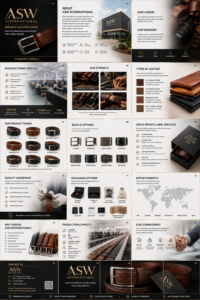
ASW International
ASW International specializes in the manufacturing and export of high-end leather accessories, engineered to meet strict commercial and retail performance standards. We provide durable, rugged goods designed for global lifestyle, retail, and wholesale markets. Our…
View profile →Sources & further research
LeatherTrade Hub uses sources to support factual context around standards, testing, regulation, trade classification and sector structure. Supplier capability, pricing and commercial claims should still be checked directly with the business.
- HS Chapter 41 — Raw hides and skins and leatherUnited Nations Statistics Division · Trade classification
Why we used it: Primary reference for internationally used HS classifications covering raw hides, skins, tanned/crust leather and finished leather.
Source checked 9 September 2026 - ISO/TC 120 — LeatherInternational Organization for Standardization (ISO) · Standards authority
Why we used it: Defines the ISO committee scope for raw hides, tanned hides, finished leather and leather products.
Source checked 9 September 2026 - Leather Manufacturer StandardLeather Working Group · Industry standard / audit framework
Why we used it: Reference for facility-level environmental, traceability, chemical-management, social and governance checks in leather manufacturing.
Source checked 9 September 2026 - ISO 20137:2023 — Guidelines for testing critical chemicals in leatherInternational Organization for Standardization (ISO) · International standard
Why we used it: Reference for leather-specific chemical-testing specifications and restricted-substance planning.
Source checked 9 September 2026 - ISO 2418:2023 — Position and preparation of specimens for leather testingInternational Organization for Standardization (ISO) · International standard
Why we used it: Reference for representative specimen location and preparation when leather is physically or chemically tested.
Source checked 9 September 2026 - ISO 11640:2018 — Colour fastness to rubbingInternational Organization for Standardization (ISO) · International standard
Why we used it: Reference for assessing leather surface behaviour and colour transfer under rubbing.
Source checked 9 September 2026 - Commission Regulation (EU) No 301/2014 — REACH restriction on chromium VI in leather articlesEUR-Lex / European Union · Legislation
Why we used it: Primary legal source for the EU restriction covering chromium VI in leather articles and leather parts that contact the skin.
Source checked 9 September 2026 - Standards Development ProgrammeLeather Working Group · Standards programme
Why we used it: Tracks the direction and maintenance of LWG standards, including the transition beyond Protocol 7.
Source checked 9 September 2026